Why Does Domain Authority Differ Between Semrush and Moz? The Real Reason
Why does domain authority differ between Semrush and Moz? Learn the key differences between Moz DA and Semrush Authority Score, including backlinks, traffic, algorithms, and data.
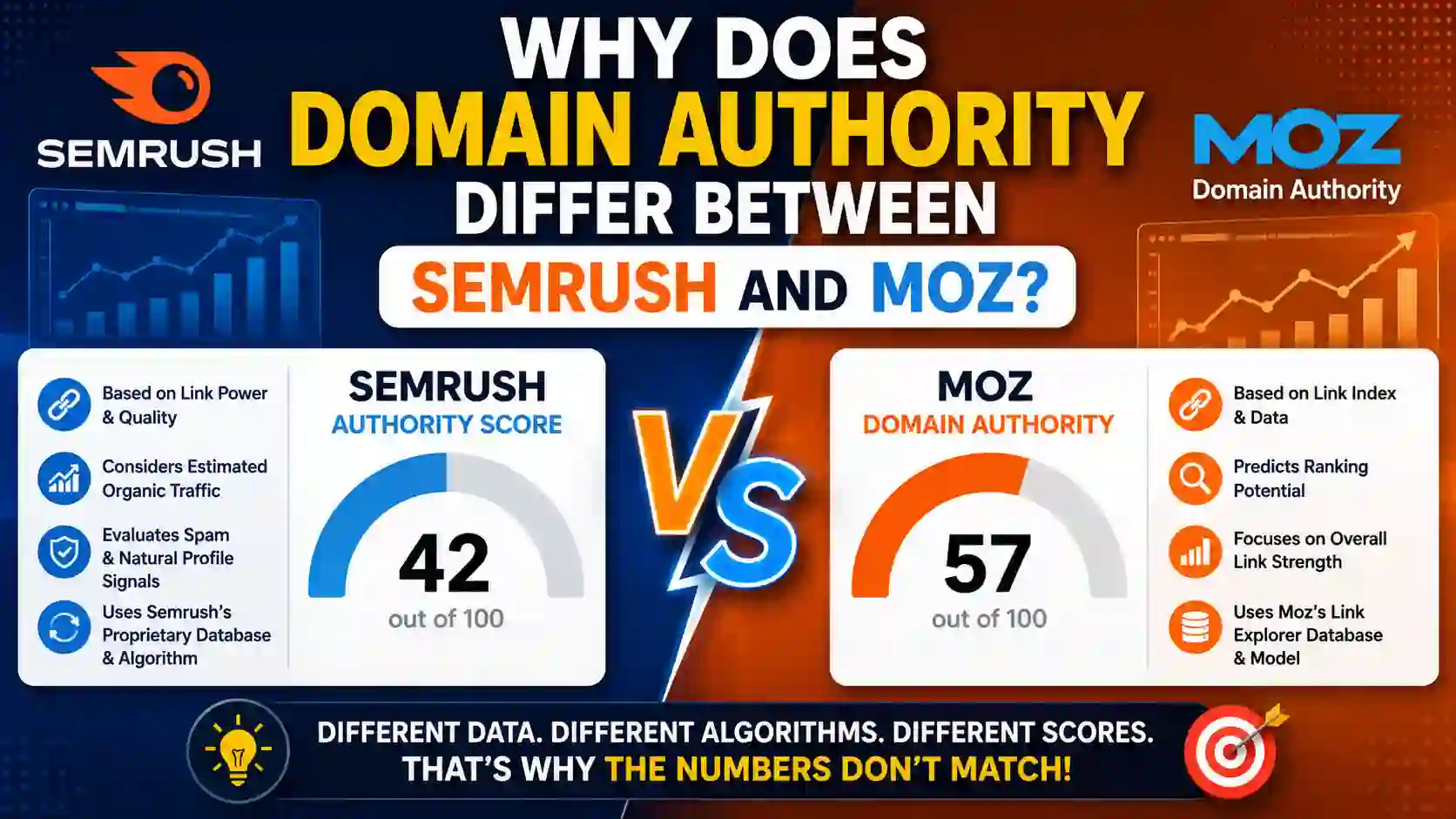
Why Does Domain Authority Differ Between Semrush and Moz? Complete Guide
If you have ever checked the same website in Semrush and Moz, you may have noticed that the authority score is not always the same. For example, Semrush might show an Authority Score of 42, while Moz might show a Domain Authority of 57. This can be confusing, especially when you are using SEO tools to evaluate your website, competitors, or potential backlink opportunities.
So, why does domain authority differ between semrush and moz?
The simple answer is that Semrush and Moz do not calculate website authority using the same formula, database, or ranking model. Semrush uses its proprietary Authority Score, while Moz uses Domain Authority (DA). Both metrics are designed to help SEO professionals estimate the strength of a website, but they measure that strength in different ways.
Semrush says its Authority Score combines link power, estimated organic traffic, and signals associated with spam or unnatural link profiles. It uses eight weighted factors across these areas. Moz Domain Authority, on the other hand, is a Moz metric designed to predict how likely a domain is to rank in Google search results using Moz's own link data and modeling.
Therefore, why does domain authority differ between semrush and moz is not a question of one platform necessarily being wrong. It is mainly a question of different data, algorithms, calculations, and interpretations.
Understanding this difference is important if you are using SEO tools for keyword research, competitor analysis, link building, guest posting, content marketing, or website audits.
Quick Answer: Why Does Domain Authority Differ Between Semrush and Moz?
The reason why does domain authority differ between semrush and moz is that the two platforms use different authority metrics.
Semrush uses Authority Score, which evaluates:
- Backlink quality and quantity
- Referring-domain strength
- Estimated organic traffic
- Dofollow backlink patterns
- Organic search visibility
- Potential spam or manipulation signals
- IP and network patterns
- Similar or duplicated backlink profiles
Semrush currently explains that Authority Score is based on three broad areas: Link Power, Organic Traffic, and Natural Profile. The Natural Profile component looks for several indicators of potentially manipulated link profiles.
Moz uses Domain Authority, which is a predictive metric designed to estimate the ranking strength of a domain based primarily on its link ecosystem and Moz's own data and model.
Because the inputs are different, the final scores can also be different.
For example:
Semrush Authority Score: 38
Moz Domain Authority: 55
This does not mean that your website has two conflicting official Google authority scores. Neither number is a Google-issued score.
They are independent SEO metrics.
That is the central explanation for why does domain authority differ between semrush and moz.
Semrush Authority Score vs Moz Domain Authority
Before going deeper into why does domain authority differ between semrush and moz, it helps to understand what each metric represents.
| Feature | Semrush Authority Score | Moz Domain Authority |
|---|---|---|
| SEO platform | Semrush | Moz |
| Metric name | Authority Score | Domain Authority |
| Scale | 1–100 | 1–100 |
| Main purpose | Estimate overall website/page quality and authority | Predict ranking strength |
| Backlinks considered | Yes | Yes |
| Referring domains | Yes | Yes |
| Organic traffic | Yes | Not the same type of direct component |
| Spam/manipulation signals | Yes | Uses its own modeling and link-related signals |
| Proprietary database | Semrush database | Moz link index |
| Ranking prediction | Indirectly related to SEO strength | Central purpose of DA |
| Google ranking factor | No | No |
| Can scores be compared directly? | No | No |
| Best use | Competitor and backlink comparison | Domain-strength comparison |
| Score should be used alone? | No | No |
Semrush itself describes Authority Score as a compound metric and says it should be used primarily for comparing domains rather than treating a particular number as an absolute definition of good or bad.
This is important because people often make the mistake of assuming that Semrush 50 = Moz 50.
That is incorrect.
A score of 50 exists within the mathematical environment of the tool that generated it. It does not automatically translate to a score of 50 in another platform.
This is one of the biggest reasons why does domain authority differ between semrush and moz.
What Is Semrush Authority Score?
Semrush Authority Score is a proprietary metric that evaluates the overall quality and authority of a website or webpage.
According to Semrush, the score is calculated using three primary categories:
- Link Power
- Organic Traffic
- Natural Profile
Link Power evaluates the quantity and quality of backlinks pointing to the website.
Organic Traffic represents estimated monthly organic search traffic.
Natural Profile examines signals that may indicate manipulation or suspicious link-building behavior.
Semrush says Authority Score is calculated using eight weighted factors. These include link power, organic traffic, lack of organic rankings, unusually high percentages of dofollow referring domains, an imbalance between links and organic traffic, excessive referring domains from the same IP, excessive referring domains from the same IP network, and the presence of another domain with an almost identical backlink profile.
This is important because Semrush is not simply counting backlinks.
Imagine a website has 10,000 backlinks but almost no organic search visibility.
Another website has 2,000 backlinks but receives substantial organic traffic and has a natural backlink profile.
A simple backlink-counting system might consider the first website stronger.
Semrush can interpret the situation differently because Authority Score considers multiple signals.
This helps explain why does domain authority differ between semrush and moz.
What Is Moz Domain Authority?
Moz Domain Authority, commonly called DA, is a metric developed by Moz to estimate how likely a domain is to rank in search engine results.
It is measured on a scale from 1 to 100.
Higher scores generally represent stronger predicted ranking ability.
However, DA should not be confused with an official Google ranking score.
Google does not give websites a public "Domain Authority" score that appears in its ranking algorithm.
Moz created DA as a useful third-party measurement for SEO professionals.
Moz uses its own link data and modeling to estimate the relative ranking strength of a domain. Semrush also describes Moz's Domain Authority as a 1–100 metric calculated from Moz's Link Explorer backlink index and a machine-learning model designed to predict ranking likelihood.
This means that why does domain authority differ between semrush and moz becomes much easier to understand once you realize that the metrics were created for different purposes and calculated using different systems.
Different Backlink Databases
One of the most important reasons behind why does domain authority differ between semrush and moz is the difference between their backlink databases.
The internet is constantly changing.
Websites publish new pages.
Old pages disappear.
Domains expire.
Links are removed.
Websites change URLs.
Pages are redirected.
New backlinks are created every day.
SEO platforms crawl the web continuously, but no two platforms have exactly the same backlink database at every moment.
For example, suppose your website has 2,000 backlinks.
Semrush might have discovered 1,600 of those links.
Moz might have discovered 1,750.
Some links could exist in both databases.
Some might exist only in Semrush.
Others might exist only in Moz.
The platforms may also process those links differently.
Consequently, the information used to calculate authority can be different.
This is one of the clearest explanations for why does domain authority differ between semrush and moz.
Different Algorithms Produce Different Scores
The second major reason for why does domain authority differ between semrush and moz is their algorithms.
Think about two financial institutions calculating a credit score.
Both may examine the same person.
However, one company may give more importance to payment history, while another may give more importance to debt utilization or account history.
The final scores can therefore differ.
SEO authority works in a similar way.
Moz has its own model.
Semrush has its own model.
Each platform decides which signals matter, how much those signals should matter, and how the final score should be scaled.
Therefore, even if both companies had identical backlink databases, the scores could still be different.
This is why trying to force Moz DA and Semrush Authority Score to match is not useful.
Semrush Considers Organic Traffic
One major factor that helps explain why does domain authority differ between semrush and moz is Semrush's use of estimated organic traffic within Authority Score.
Semrush states that its organic traffic component is estimated using keyword positions and the click potential associated with those positions.
This means two websites with similar backlink profiles may not necessarily receive similar Authority Scores.
Imagine:
Website A
- 500 referring domains
- Strong backlinks
- 50,000 estimated monthly organic visits
Website B
- 550 referring domains
- Similar backlink count
- Very little organic search traffic
A simple backlink-focused system could view these websites as similar.
Semrush's model has additional information to consider.
That can result in a meaningful difference in Authority Score.
This is another major factor behind why does domain authority differ between semrush and moz.
Spam and Manipulation Signals
Semrush also evaluates signals associated with potentially unnatural link profiles.
For example, Semrush says its Natural Profile component considers:
- No organic rankings
- Unusually high percentages of dofollow referring domains
- Imbalance between backlinks and organic traffic
- Too many referring domains sharing an IP
- Too many referring domains sharing an IP network
- Nearly identical backlink profiles across domains
This means a website cannot necessarily increase its Semrush Authority Score simply by accumulating a huge number of backlinks.
Suppose a website has 5,000 referring domains.
That sounds impressive.
But if many of those domains are low-quality, highly similar, hosted within suspicious patterns, or generate almost no organic visibility, the backlink count alone does not tell the complete story.
This is an important reason why does domain authority differ between semrush and moz.
Link Quality Matters More Than Link Quantity
Another reason why does domain authority differ between semrush and moz is that backlinks are not equal.
One backlink from a highly relevant and trusted publication may be more useful than hundreds of unrelated links.
Consider two websites.
Website A
- 100 relevant referring domains
- Strong editorial links
- Natural anchor text
- Good organic visibility
Website B
- 1,000 unrelated referring domains
- Many low-quality links
- Repetitive anchor text
- Very little organic traffic
Looking only at the number of referring domains could make Website B appear stronger.
But a sophisticated authority model can interpret these profiles differently.
This is why you should never judge a website's SEO strength solely by counting backlinks.
Different Interpretations of Referring Domains
A referring domain is a website that links to your website.
For example, if five pages on one website link to your website, that is still generally one referring domain.
This distinction matters because 1,000 backlinks do not necessarily mean 1,000 independent websites recommend your content.
A site with 300 high-quality referring domains may be stronger than a site with 10,000 backlinks from only a small number of domains.
Semrush explicitly incorporates referring-domain quality and quantity into its Link Power calculation.
Moz also relies heavily on link-based information in its authority modeling.
However, their databases and calculations are different.
This creates another explanation for why does domain authority differ between semrush and moz.
Domain-Level Authority vs Page-Level Strength
Another important concept is the difference between domain authority and page-level authority.
A website can have a high overall authority score while a particular page on that website has relatively few backlinks.
For example:
Domain: Strong
New Article: Weak
A new page may not immediately inherit all the practical ranking strength that an established page with years of backlinks has.
Therefore, when evaluating a backlink opportunity, don't only look at the domain-level number.
Also investigate:
- The specific page
- Its backlinks
- Organic traffic
- Ranking keywords
- Relevance
- Content quality
- Page history
This is particularly important when researching guest-post opportunities.
It also reinforces why does domain authority differ between semrush and moz because even within the same platform, domain-level and page-level measurements can provide different perspectives.
Different Update Schedules
Another reason why does domain authority differ between semrush and moz is that SEO tools do not necessarily refresh their datasets simultaneously.
Semrush states that Authority Scores for domains are updated every two weeks.
Other metrics and databases can update on different schedules.
Moz has its own crawling and indexing processes.
Suppose you earn 50 strong backlinks this month.
Semrush may detect some of them before Moz.
Or Moz may discover them before Semrush.
The result is that the same website can temporarily show different authority levels across platforms.
Over time, the scores may move closer together, remain different, or move further apart.
That is normal.
Why Scores Can Change Without Major SEO Changes?
Website owners sometimes become concerned when their Semrush or Moz score changes even though they have not built new backlinks.
This can happen for several reasons.
A third-party metric can change because:
- A backlink was discovered
- A backlink disappeared
- A referring domain expired
- A website changed its link structure
- The platform updated its index
- Ranking data changed
- Organic traffic estimates changed
- The scoring model changed
- Competitors changed their profiles
Authority scores are relative measurements.
Therefore, a score can move even when you have not deliberately changed your website.
This is another reason why does domain authority differ between semrush and moz.
Why a Website Can Have High Moz DA but Lower Semrush Authority Score?
Imagine a website has:
Moz DA: 65
Semrush Authority Score: 38
This can look strange at first.
However, it may be explained by the different models.
The website might have a substantial backlink profile recognized by Moz but relatively weak estimated organic traffic or backlink characteristics that Semrush evaluates differently.
Semrush's Authority Score specifically includes organic traffic and several natural-profile checks.
Therefore, a high Moz DA does not guarantee a similarly high Semrush Authority Score.
This is one of the most common examples of why does domain authority differ between semrush and moz.
Why a Website Can Have Higher Semrush Authority Score Than Moz DA?
The reverse can also happen.
For example:
Semrush Authority Score: 58
Moz DA: 45
Potential explanations include:
- Semrush has discovered stronger backlinks
- Semrush estimates stronger organic traffic
- Moz has different backlink coverage
- The models assign different weights to links
- The platforms have different update schedules
- The website's link profile is interpreted differently
Again, there is no requirement for both scores to match.
This is another example of why does domain authority differ between semrush and moz.
Are Moz DA and Semrush Authority Score Comparable?
They are comparable only at a broad conceptual level.
Both are designed to help SEO professionals understand website strength.
However, they are not interchangeable.
For example:
Moz DA 50 ≠ Semrush Authority Score 50
The numbers may look identical, but the underlying meaning is different.
This is similar to comparing scores from two different examinations.
A 70 on one exam does not necessarily equal a 70 on another exam because the grading systems may be different.
Therefore, why does domain authority differ between semrush and moz is not surprising once you understand that the two metrics use different measurement systems.
Does Google Use Domain Authority?
No.
This is one of the most important things to understand.
Moz Domain Authority is not an official Google ranking factor.
Semrush Authority Score is also not an official Google ranking factor.
Google does not look at a website and say:
"Your Moz DA is 60, so you should rank above this website."
These are third-party SEO metrics.
They are useful because they simplify complicated SEO information into numbers that can be compared.
However, they should never be treated as Google's actual ranking score.
Understanding this distinction makes why does domain authority differ between semrush and moz much less confusing.
Does a Higher Authority Score Guarantee Better Rankings?
No.
A website with an Authority Score of 70 can rank below a website with an Authority Score of 35 for a particular keyword.
Why?
Because rankings depend on many factors, including:
- Search intent
- Content relevance
- Content quality
- Backlinks
- Topical relevance
- Internal linking
- Technical SEO
- User experience
- Competition
- Query context
- Location
- Language
Authority is only one part of the overall SEO picture.
This is why you should not build your entire SEO strategy around increasing one third-party score.
Does a Higher DA Guarantee Better Rankings?
No.
The same principle applies to Moz DA.
DA is a predictive metric, not a ranking guarantee.
A website with DA 30 can sometimes outrank a website with DA 60 because its page may better satisfy the search intent.
For example, imagine someone searches:
"How to configure WordPress SSL."
A smaller technical website might have DA 35 but publish an extremely detailed tutorial.
A large website with DA 70 might have a short article that barely answers the question.
The smaller website can still compete.
This demonstrates why why does domain authority differ between semrush and moz is less important than understanding how to use authority metrics properly.
How to Compare Your Website Using Both Tools?
Instead of trying to determine which score is correct, use both tools as comparative indicators.
Start by recording:
| Metric | Your Website | Competitor A | Competitor B |
| Moz DA | 42 | 51 | 63 |
| Semrush Authority Score | 35 | 48 | 57 |
| Referring Domains | 210 | 340 | 510 |
| Organic Traffic | 15,000 | 30,000 | 55,000 |
| Ranking Keywords | 2,800 | 5,100 | 8,900 |
| Top 10 Keywords | 450 | 820 | 1,400 |
The numbers in this table are illustrative.
The purpose is to show how you can look beyond one authority score.
If your DA is lower than your competitor's, ask why.
Does the competitor have more referring domains?
Does the competitor have stronger content?
Does it have more organic traffic?
Does it rank for more keywords?
Does it have greater topical authority?
These questions are far more useful than simply asking which tool reports the higher number.
What Should You Focus on Instead of Authority Score?
When analyzing SEO performance, track several metrics.
Organic Traffic
Is search traffic increasing?
Ranking Keywords
Are you ranking for more relevant terms?
Top 10 Rankings
Are your important keywords moving toward the first page?
Referring Domains
Are you earning links from new, legitimate websites?
Backlink Quality
Are those links relevant and valuable?
Content Performance
Are your articles attracting impressions, clicks, links, and conversions?
Conversions
Is organic traffic generating leads, sales, or affiliate revenue?
These metrics provide a more complete picture.
They also help explain why does domain authority differ between semrush and moz without making the authority score the center of your SEO strategy.
Should You Try to Increase Your DA?
You should improve the factors that influence your website's authority, but you should not obsess over the number itself.
Instead of thinking:
"How can I increase DA from 30 to 50?"
Think:
"How can I make my website more useful and authoritative?"
That means:
- Publish original content
- Improve existing articles
- Earn relevant backlinks
- Build topical depth
- Improve internal linking
- Fix technical SEO issues
- Improve search visibility
- Build relationships with legitimate websites
- Avoid manipulative link schemes
If you improve these underlying areas, third-party authority metrics may improve as a result.
Should You Try to Increase Semrush Authority Score?
The same principle applies.
Do not build backlinks simply because you want to increase Authority Score.
Semrush's own documentation explains that Authority Score is best used for comparing domains rather than defining an absolute good or bad score.
Instead, improve your website's underlying quality.
A healthy SEO strategy should produce:
- Better rankings
- More relevant traffic
- Better content
- Stronger backlinks
- Greater topical authority
- More conversions
Authority Score can then be used as one measurement of progress.
Why You Should Not Buy Cheap Backlinks for Authority?
Some website owners see a low DA or Authority Score and immediately purchase hundreds of backlinks.
This can be a mistake.
Buying large quantities of unrelated, low-quality backlinks may increase the number of links without improving the actual quality of your website.
You could end up with:
- Irrelevant referring domains
- Artificial anchor text
- Poor-quality websites
- Link-network patterns
- Little organic traffic
- Weak topical relevance
Semrush specifically incorporates several signals intended to identify potentially manipulated link patterns.
Therefore, the better strategy is to earn links through useful content, digital PR, genuine outreach, research, tools, original data, and valuable resources.
Important Links and Information
| Resource | Purpose | Important Information |
| Semrush Authority Score documentation | Understand Authority Score | Explains Link Power, Organic Traffic, Natural Profile, and the eight weighted factors. |
| Semrush Website Authority Checker | Check website authority | Provides Authority Score, backlinks, referring domains, estimated organic traffic, and related information. |
| Semrush Authority Score announcement | Understand the methodology update | Explains the revamped Authority Score methodology introduced by Semrush. |
| Moz | Check Domain Authority and link metrics | Moz Domain Authority is a third-party 1–100 metric based on Moz's own link data and modeling. |
| Google Search | Validate actual competition | Use the live search results to manually evaluate the websites ranking for your target keywords. |
How to Analyze a Potential Backlink Website?
If you are using DA or Authority Score to evaluate a website for link building, don't stop at the number.
Check:
1. Organic Traffic
Does the website actually receive search traffic?
2. Ranking Keywords
Does it rank for meaningful keywords?
3. Topical Relevance
Is the website relevant to your niche?
4. Referring Domains
Does it have genuine referring domains?
5. Content Quality
Does the website publish useful, original content?
6. Link Profile
Are its backlinks natural?
7. Traffic Trend
Is organic visibility growing or declining?
This approach is much safer than saying:
"DA 60 means this is a good website."
The same principle applies to Authority Score.
A high number is useful information, but it is not enough by itself.
Why Authority Metrics Are Best Used for Comparison?
Semrush explicitly recommends using Authority Score for domain comparison rather than judging whether a number is absolutely good or bad.
This is an important concept.
Suppose you operate a new blog with:
DA 25
Your competitor has:
DA 30
That difference may be relatively small.
But if another competitor has:
DA 80
you may need a very different strategy.
Similarly, an Authority Score of 35 could be excellent for one niche and weak for another.
The competitive environment matters.
Therefore, instead of asking:
"Is 40 a good Authority Score?"
Ask:
"How does 40 compare with the websites competing for my target keywords?"
This is a much more useful SEO question.
A Practical Example of Semrush vs Moz
Imagine you run a hosting website.
You check your domain and receive:
Moz DA: 52
Semrush Authority Score: 39
You then check three competitors.
| Website | Moz DA | Semrush Authority Score | Organic Traffic |
| Your Website | 52 | 39 | 20,000 |
| Competitor A | 58 | 44 | 35,000 |
| Competitor B | 48 | 41 | 28,000 |
| Competitor C | 65 | 56 | 80,000 |
Instead of worrying that your Semrush score is lower than your Moz score, you can analyze the competitive landscape.
Competitor C has:
- Higher authority
- Higher organic traffic
- More likely stronger backlinks
- Greater overall search visibility
That gives you a clear SEO objective.
You can research how Competitor C earns backlinks, which pages generate traffic, what keywords it ranks for, and where its content is stronger.
This is a much better use of authority metrics.
What If Your Authority Score Suddenly Drops?
Do not panic immediately.
First check:
- Did you lose important referring domains?
- Did your organic traffic estimates change?
- Did Semrush update its database?
- Did your ranking keywords decline?
- Did competitors gain stronger links?
- Did the backlink profile change?
- Did the tool update its methodology?
Semrush says Authority Scores are refreshed periodically, so changes can occur as new information enters the system.
A decline in a third-party metric does not automatically mean Google has penalized your website.
You should always check your actual SEO performance separately.
What If Moz DA Drops?
The same principle applies.
A decline in DA does not automatically mean your website has been penalized by Google.
DA is Moz's own metric.
Check:
- Lost backlinks
- Lost referring domains
- Changes in your link profile
- Competitor changes
- Moz index changes
- Actual organic traffic
- Google rankings
If your Google traffic and rankings remain stable, a change in DA may not have any meaningful business impact.
Final Conclusion: Why Does Domain Authority Differ Between Semrush and Moz?
So, why does domain authority differ between semrush and moz?
The answer is that Semrush and Moz are measuring website authority through different systems.
Semrush uses Authority Score, a compound metric that incorporates link power, estimated organic traffic, and natural-profile or spam-related signals. Semrush currently describes eight weighted factors behind the score.
Moz uses Domain Authority, a proprietary metric designed to predict the relative ranking strength of a domain using Moz's own link data and modeling.
Because the two platforms use different databases, algorithms, crawling processes, authority models, and calculations, their scores do not need to match.
If your website has a Moz DA of 55 and a Semrush Authority Score of 40, that does not automatically mean something is wrong.
It simply means the two platforms are looking at your website through different measurement systems.
The most important lesson from why does domain authority differ between semrush and moz is that you should never treat either number as Google's official assessment of your website.
Instead, use authority metrics as comparative SEO tools.
Compare your website with competitors.
Study referring domains.
Analyze backlink quality.
Monitor organic traffic.
Track keyword rankings.
Improve your content.
Build topical authority.
Earn relevant backlinks.
Most importantly, measure the actual results produced by your SEO strategy.
A website with a lower third-party authority score can still generate more traffic, rank for more valuable keywords, and produce more revenue than a website with a higher score.
Therefore, don't spend all your time trying to make Moz and Semrush show the same number.
They are not designed to do that.
Use the differences to understand your website from multiple perspectives. If both tools show improvement over time, that can be encouraging. If one score drops, investigate the underlying data before assuming that your SEO performance has declined.
Ultimately, the real goal is not to achieve a DA of 50, an Authority Score of 50, or any other arbitrary number.
The goal is to build a website that earns trust, provides genuinely useful content, attracts relevant backlinks, ranks for valuable searches, receives qualified organic traffic, and produces meaningful business results.
Once you understand why does domain authority differ between semrush and moz, the different numbers become much less confusing. Instead of asking which platform is right, you can ask the more valuable question: What does the data tell me about my website, my competitors, and my SEO opportunities?
That is the approach that turns authority metrics from confusing numbers into useful SEO insights.
Frequently Asked Questions
Verified Expert in deals and money-saving tips




No comments yet. Be the first to share your thoughts!