Namecheap vs Hostinger Comparison 2026: Which Is Better?
Namecheap vs Hostinger comparison 2026: Compare pricing, speed, WordPress, features, security, support, domains, and hosting to find the better provider.
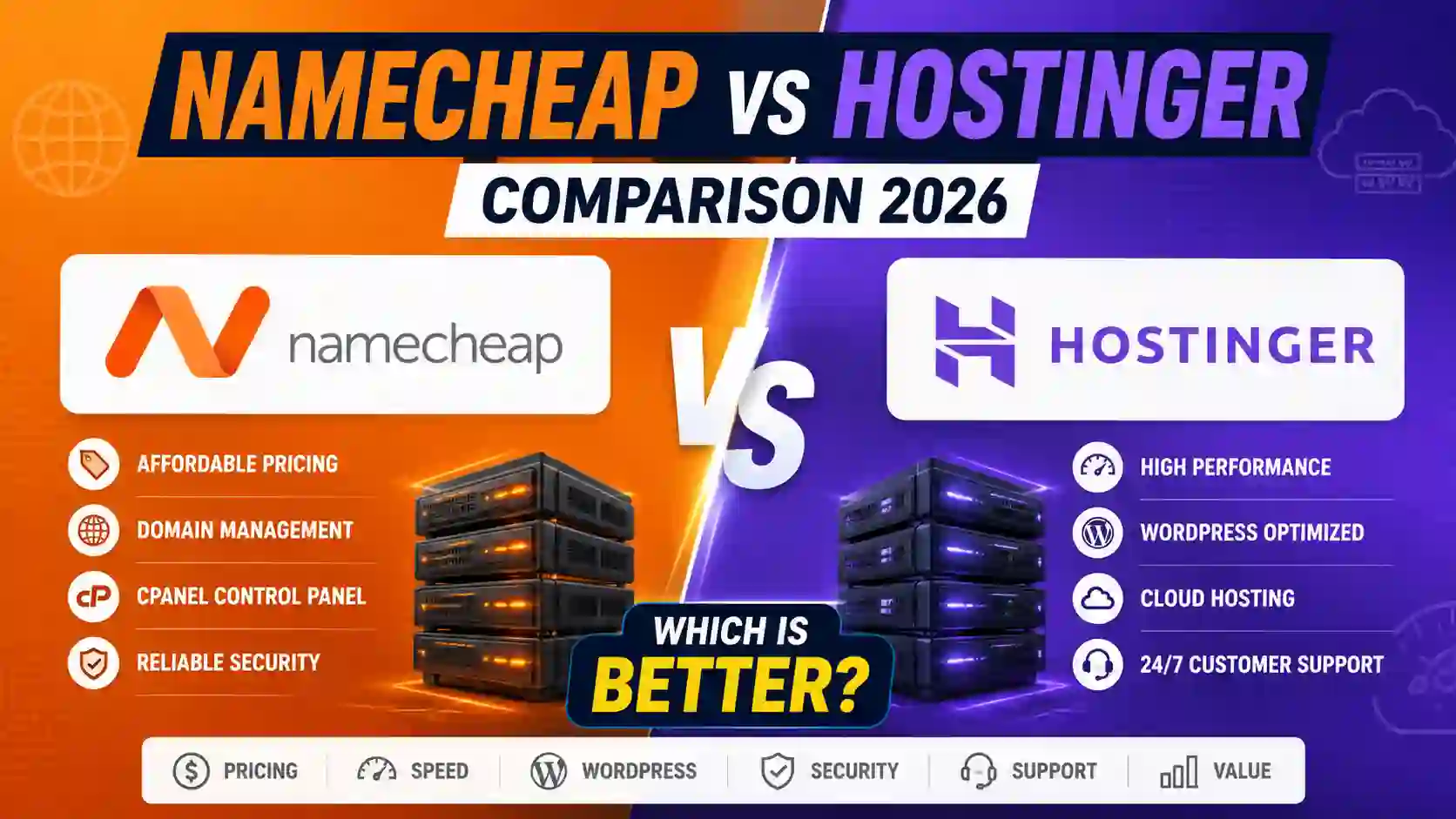
Namecheap vs Hostinger Comparison 2026
Choosing the right web hosting provider can have a major impact on your website’s speed, uptime, security, scalability, and long-term cost. Two popular names that frequently appear in hosting comparisons are Namecheap and Hostinger. Both offer affordable hosting, domain registration, WordPress hosting, email, SSL certificates, website-building tools, and options for users who want to start or grow a website.
But which one is actually better in 2026?
In this Namecheap vs Hostinger comparison 2026, we will compare the two providers across pricing, hosting features, performance, WordPress hosting, domains, SSL, backups, security, customer support, ease of use, website migration, scalability, and overall value.
The important thing to understand is that Namecheap and Hostinger have slightly different strengths. Namecheap has traditionally been particularly attractive to users who want affordable domains and straightforward hosting, while Hostinger has increasingly focused on performance, managed hosting, WordPress, AI-powered tools, and an easy website-building experience.
For users comparing hosting providers in 2026, the better choice depends on what you need from your website.
Namecheap vs Hostinger Comparison 2026 at a Glance
Here is a quick overview before we examine each category in detail.
Both providers are capable choices, but Hostinger has a stronger overall emphasis on performance and an integrated website-building experience, while Namecheap remains particularly attractive for domain buyers and users who prefer traditional hosting tools such as cPanel.

Get the Latest Namecheap Coupons & Deals
Save more on domains and web hosting with the latest verified Namecheap coupons, promo codes, and exclusive deals.

Get the Latest Hostinger Coupons & Deals
Save on web hosting with the latest Hostinger coupon codes, exclusive discounts, and verified hosting deals.
What Is Namecheap?
Namecheap is a well-known domain registrar and hosting company. The company offers domain registration, shared hosting, WordPress hosting, VPS hosting, SSL certificates, email services, website builders, and other online services.
One of Namecheap's biggest advantages is that users can manage domains and hosting from the same ecosystem.
Its shared hosting lineup currently includes Stellar, Stellar Plus, and Stellar Business. Namecheap's current shared hosting page lists features such as SSD storage, email accounts, automatic SSL, CDN, free migration, and cPanel.
Namecheap also offers a 30-day free trial on its current shared hosting plans, subject to its stated eligibility and trial conditions.
This makes Namecheap particularly interesting for users who want to test hosting before committing.
What Is Hostinger?
Hostinger is a global hosting company that offers shared hosting, WordPress hosting, cloud hosting, VPS hosting, domains, email, website builders, and AI-powered website tools.
Hostinger has positioned its hosting around ease of use and performance. Its current hosting plans include features such as SSD or NVMe storage, CDN, SSL, backups, email, WordPress support, website-building tools, AI tools, and 24/7 support.
For users in India, Hostinger currently advertises plans beginning at promotional prices as low as ₹69 per month when purchased for a 48-month term. However, introductory pricing should always be separated from renewal pricing when calculating the long-term cost.
Hostinger also offers higher-tier cloud hosting for websites that need more resources than traditional shared hosting. Its Cloud Startup plan currently includes features such as 4 CPU cores, 4 GB RAM, 100 GB NVMe storage, unlimited websites, CDN, managed hosting, and a free domain for one year under eligible terms.
Namecheap vs Hostinger Pricing
Pricing is one of the biggest reasons people compare Namecheap and Hostinger.
However, hosting prices can be misleading if you only look at the promotional monthly price.
Both providers use promotional pricing, and the price can depend on the billing period, currency, region, plan, and current promotion.
Namecheap Pricing
Namecheap's current shared hosting lineup includes:
- Stellar
- Stellar Plus
- Stellar Business
The current advertised promotional price for Stellar starts at $2.28 per month, while Stellar Plus starts at $2.98 per month and Stellar Business at $4.98 per month under the displayed promotional terms.
Namecheap also changed shared-hosting renewal pricing in May 2026. The published renewal prices are $5.88 per month for Stellar, $7.88 per month for Stellar Plus, and $11.88 per month for Stellar Business when billed monthly. Annual and two-year renewal prices are also published by Namecheap.
Therefore, you should not judge Namecheap purely by its introductory price.
Hostinger Pricing
Hostinger's current India pricing shows its Single plan at ₹69 per month for a 48-month term, Premium at ₹139 per month, and Unlimited at ₹199 per month under the displayed promotion. Renewal prices are higher.
For example, the currently displayed 48-month Single plan is ₹3,312 in total and renews at ₹289 per month. The Premium plan is ₹6,672 for 48 months and renews at ₹449 per month.
This demonstrates why the total initial commitment and renewal price should both be considered.
Which Is Cheaper?
There is no permanent winner because hosting promotions change.
For a user in India looking at current promotional pricing, Hostinger can be extremely competitive, particularly when purchasing a long-term plan.
Namecheap can also be highly competitive, especially for users who value its domain services and want traditional shared hosting.
The important point is to compare the total first-term cost plus renewal cost, rather than simply comparing the advertised monthly number.
Namecheap vs Hostinger: Hosting Features
Features are another area where the providers are closely matched.
Namecheap's shared hosting plans currently include free SSL, unmetered bandwidth, free migration, CDN, email, and WordPress/cPanel support. Higher plans add features such as automatic backups and additional resources.
Hostinger's current hosting plans include SSL, backups, CDN, email, website-building tools, WordPress, AI tools, and ecommerce functionality. Higher plans provide more websites, storage, backups, and other resources.
Feature comparison
| Feature | Namecheap | Hostinger |
| SSL | Yes | Yes |
| CDN | Yes | Yes |
| Website migration | Free on eligible hosting | Free |
| WordPress | Yes | Yes |
| Yes | Yes | |
| Website builder | Yes | Yes |
| AI tools | Yes | Yes |
| Backups | Plan dependent | Plan dependent |
| Multiple websites | Higher plans | Higher plans |
| Ecommerce | Supported | Supported |
| VPS | Yes | Yes |
| Cloud hosting | Available through hosting lineup | Yes |
| Managed options | Available | Strong focus |
For a beginner who wants an all-in-one package, Hostinger has a slight advantage because of the way hosting, website building, WordPress, AI tools, CDN, email, and performance features are integrated.
Namecheap vs Hostinger Performance
Performance is one of the most important factors when choosing hosting.
A hosting company's advertised specifications do not automatically guarantee that every website will have identical performance. Website speed also depends on the WordPress theme, plugins, image sizes, caching, database queries, CDN configuration, traffic, server location, and optimization.
Hostinger currently emphasizes NVMe storage on higher plans, LiteSpeed-based infrastructure, CDN, and object caching. Its hosting page also states that its infrastructure is designed to handle traffic spikes and that users can upgrade to cloud hosting when they need more resources.
Namecheap's shared hosting uses SSD storage and includes CDN services. Its shared hosting documentation also describes SSD-based infrastructure and resource improvements across its plans.
Which is faster?
For a basic WordPress website, either provider can deliver good performance when the website is properly optimized.
However, Hostinger gets the advantage for users who prioritize performance-oriented infrastructure and modern managed hosting features.
If you are running a content-heavy website, ecommerce store, or growing WordPress website, the specific hosting tier matters more than the brand name alone.
Namecheap vs Hostinger for WordPress
WordPress is one of the most common reasons people buy hosting.
Both Namecheap and Hostinger support WordPress.
Namecheap provides WordPress installation through its hosting environment and supports WordPress through cPanel and related tools. Its shared hosting plans also advertise AI-powered WordPress functionality.
Hostinger provides WordPress hosting and includes WordPress-related tools in its hosting ecosystem. Its current plans also combine WordPress with website-building, AI, performance, security, and ecommerce features.
Which is better for WordPress?
For someone who is completely new to WordPress, I would choose Hostinger.
The reason is not that Namecheap cannot run WordPress. It can. The advantage is that Hostinger puts more emphasis on an integrated beginner experience.
For experienced WordPress users who prefer cPanel and traditional hosting management, Namecheap may be more appealing.
Namecheap vs Hostinger for Beginners
Beginners generally want five things:
- Easy setup
- Affordable pricing
- Simple website management
- Reliable support
- Tools that reduce technical work
Both companies satisfy these requirements.
Hostinger has a particularly beginner-focused interface and combines its hosting with a drag-and-drop website builder, AI tools, WordPress, ecommerce functionality, and managed services.
Namecheap also provides an easy setup experience, cPanel, one-click installation, website-building tools, and migration assistance.
Winner for beginners: Hostinger
If you have never created a website before, Hostinger is the easier overall recommendation.
If you already understand cPanel, domains, FTP, DNS, and traditional hosting management, Namecheap becomes more attractive.
Namecheap vs Hostinger for Domain Names
This is where Namecheap has a particularly strong reputation.
Namecheap is primarily known as a domain registrar and has built a large ecosystem around domain names.
If your main requirement is buying and managing domains, Namecheap is an excellent option.
Hostinger also sells domains and provides free domain registration with eligible hosting plans. However, users who manage a large domain portfolio may prefer a registrar-focused platform.
Winner for domains: Namecheap
If you are primarily looking for a domain registrar, I would choose Namecheap.
If you are purchasing hosting and want a domain included with the hosting plan, Hostinger can be more convenient.
Namecheap vs Hostinger for Email
Professional email is important for businesses.
For example:
Namecheap's shared hosting plans include email accounts, with higher plans offering substantially larger email allowances.
Hostinger also includes email on eligible hosting plans. Current plans advertise mailboxes included for a specified period, with the quantity depending on the plan.
For a small website or personal project, either provider should be sufficient.
For businesses with many email accounts, compare the exact mailbox limits and renewal conditions before purchasing.
Namecheap vs Hostinger for Security
Security should never be treated as an optional hosting feature.
Both providers offer SSL certificates and security-related services.
Namecheap's shared hosting currently includes automatic SSL installation and CDN-related security features. Its Business plan also includes Imunify360 protection.
Hostinger includes SSL, malware scanning, domain privacy, IP and country blocking, and other built-in security features on its hosting plans.
Neither provider eliminates the need for website-level security.
You should still:
- Keep WordPress updated.
- Update plugins and themes.
- Use strong passwords.
- Enable two-factor authentication where available.
- Keep independent backups.
- Avoid nulled themes and plugins.
- Use a reputable security plugin when appropriate.
Security winner
This category is close.
Hostinger has a slight advantage for the overall integrated security experience, while Namecheap is also a strong option.
Namecheap vs Hostinger for Backups
Backups are extremely important because a website can be damaged by:
- Plugin conflicts
- Malware
- Human mistakes
- Failed updates
- Database problems
- Server issues
Namecheap provides automatic backup functionality on selected shared hosting plans. Its Stellar Plus and Stellar Business plans currently advertise AutoBackup.
Hostinger also includes backups, with backup frequency depending on the hosting plan. Its current higher-tier plans include daily backups and easy data restoration.
For important websites, however, do not rely exclusively on hosting-provider backups.
Maintain an independent backup outside your hosting account whenever possible.
Namecheap vs Hostinger Customer Support
Customer support can become extremely important when your website goes down.
Both providers advertise 24/7 support.
Namecheap provides 24/7 customer support through its support system and live chat for hosting customers.
Hostinger also advertises 24/7 customer support with its hosting plans.
The quality of a support interaction can vary depending on the complexity of the problem and the particular support agent.
Winner: Hostinger
For beginners, Hostinger has an advantage because its ecosystem is designed around simplifying hosting management.
Namecheap remains a solid choice for technically comfortable users.
Namecheap vs Hostinger Ease of Use
Ease of use matters because most website owners do not want to spend hours configuring a server.
Hostinger uses its own hosting management interface, which is designed to simplify common tasks.
Namecheap's shared hosting uses cPanel, which is one of the most widely recognized hosting control panels.
This creates an interesting difference.
Hostinger
Best for users who want:
- A modern interface
- Simple setup
- Guided website creation
- AI tools
- Managed hosting
- Integrated WordPress tools
Namecheap
Best for users who want:
- cPanel
- Familiar traditional hosting tools
- Domain management
- More conventional hosting workflows
- Direct control over hosting settings
There is no universal winner here.
If you already know cPanel, Namecheap may actually feel easier.
If you are new to hosting, Hostinger may feel more intuitive.
Namecheap vs Hostinger for Website Migration
Changing hosting companies can be stressful.
Fortunately, both providers offer migration assistance.
Namecheap states that free migration is available for new hosting plans and says its team can handle migration with a target transfer period of 24 hours and zero downtime under its stated service conditions.
Hostinger also advertises free website migration with its hosting service.
This makes both providers suitable if you already have a website hosted somewhere else.
Before migration, always create a full backup of your website and database.
Namecheap vs Hostinger for Multiple Websites
If you plan to host several websites, the entry-level plan is usually not enough.
Namecheap's Stellar plan supports three websites, while Stellar Plus and Stellar Business support unlimited websites under the current shared-hosting structure.
Hostinger's current Premium plan supports three websites, while its Unlimited plan supports unlimited websites.
Therefore, both providers can work well for freelancers, agencies, and website owners managing multiple projects.
For multiple WordPress sites, compare:
- CPU resources
- RAM allocation
- Storage
- PHP workers
- Backup frequency
- Database limits
- Email limits
- Renewal price
Do not choose a plan only because it says "unlimited."
Namecheap vs Hostinger for Ecommerce
If you want to build an ecommerce store, performance and scalability become more important.
Hostinger's current plans include integrated ecommerce capabilities, WordPress support, CDN, AI tools, and higher-tier resources.
Namecheap can also host ecommerce websites through WordPress, WooCommerce, and other supported applications.
For a small ecommerce store, either can work.
For a growing store with substantial traffic, I would look beyond basic shared hosting and consider a higher-resource cloud or VPS plan.
Winner for ecommerce: Hostinger
Hostinger gets the advantage because of its stronger emphasis on managed cloud infrastructure and performance-oriented hosting.
Namecheap vs Hostinger for VPS and Cloud Hosting
Shared hosting is ideal for beginners, but websites eventually grow.
When traffic increases, you may need:
- More CPU
- More RAM
- Faster storage
- Better isolation
- More PHP workers
- Dedicated resources
- Advanced server configuration
Namecheap offers VPS hosting, while Hostinger offers VPS and managed cloud hosting options.
Hostinger's current Cloud Startup plan is designed for business and ecommerce websites and includes four CPU cores, 4 GB RAM, 100 GB NVMe storage, unlimited websites, CDN, managed hosting, and other features under the current plan configuration.
This makes Hostinger a strong option for websites that expect to grow beyond basic shared hosting.
Namecheap vs Hostinger: Who Should Choose Namecheap?
Namecheap is a strong choice if:
- You primarily need domain registration.
- You manage multiple domains.
- You prefer cPanel.
- You want traditional hosting management.
- You want affordable shared hosting.
- You need hosting and domain services from the same company.
- You want a straightforward hosting environment.
- You are comfortable managing your own WordPress website.
Namecheap is especially attractive for users who treat domains as an important part of their online business.
Who Should Choose Hostinger?
Hostinger is a strong choice if:
- You are creating your first website.
- You want an easy hosting dashboard.
- You want WordPress hosting.
- You want integrated AI website tools.
- You want a website builder.
- You want strong performance-focused infrastructure.
- You plan to host multiple websites.
- You want to upgrade to cloud hosting later.
- You are building a business website or ecommerce store.
- You want a simple all-in-one hosting platform.
For most beginners in 2026, Hostinger is the easier recommendation.
Namecheap vs Hostinger: Pros and Cons
Namecheap Pro and Cons
Pros
Cons
Hostinger Pro and Cons
Pros
Cons
Namecheap vs Hostinger: Which Is Better for SEO?
Neither hosting provider automatically gives your website better Google rankings.
SEO performance depends on many factors, including:
- Website speed
- Mobile usability
- Technical SEO
- Content quality
- Internal linking
- Backlinks
- Crawlability
- Structured data
- Core Web Vitals
- Server response time
- Website reliability
A good hosting provider can help by giving you a stable and fast environment, but hosting alone does not make a website rank.
For SEO-focused WordPress websites, I would lean toward Hostinger if performance and easy optimization are priorities.
However, a well-optimized Namecheap website can also perform very well.
Namecheap vs Hostinger for Affiliate Websites
Affiliate marketers often need hosting that can handle content-heavy websites.
An affiliate website may contain:
- Hundreds or thousands of articles
- Product images
- Comparison tables
- Affiliate links
- Tracking scripts
- Analytics
- WordPress plugins
- Search functionality
- Product databases
For a small affiliate website, both providers can work.
For a growing affiliate website with significant traffic, I would choose Hostinger's higher-tier hosting or cloud infrastructure rather than relying indefinitely on entry-level shared hosting.
The most important factor is scalability.
You should be able to upgrade resources without rebuilding the entire website.
Namecheap vs Hostinger for Small Business Websites
For a small business website, both providers are good options.
If you need:
- Company website
- Contact page
- About page
- Service pages
- Blog
- Business email
- SSL
- WordPress
either provider can meet the requirements.
Hostinger gets a slight advantage for business owners who want an all-in-one website-building experience.
Namecheap is attractive for business owners who already understand domains and traditional hosting.
Namecheap vs Hostinger: Final Verdict
After comparing pricing, performance, WordPress support, domains, security, backups, email, support, ease of use, and scalability, the answer depends on your priorities.
Hostinger is the better overall hosting choice for most beginners and growing websites in 2026.
Its combination of affordable promotional pricing, performance-focused infrastructure, WordPress support, CDN, AI tools, website builder, backups, migration, and cloud hosting makes it a strong all-around platform. Current Hostinger plans also provide a clear path from entry-level hosting to higher-resource cloud hosting.
Namecheap is the better choice if domains are your primary priority or if you specifically want traditional cPanel-based hosting.
Namecheap's current shared hosting plans provide strong value, and its domain ecosystem remains one of its biggest advantages.
Our recommendation
| User Type | Recommended Provider |
| Complete beginner | Hostinger |
| WordPress beginner | Hostinger |
| Small business | Hostinger |
| Affiliate website | Hostinger |
| Ecommerce website | Hostinger |
| Multiple websites | Hostinger / Namecheap |
| Domain-focused user | Namecheap |
| cPanel user | Namecheap |
| Domain portfolio management | Namecheap |
| Traditional hosting user | Namecheap |
| Growing website | Hostinger |
| Performance-focused website | Hostinger |
| Budget-conscious beginner | Hostinger |
| Advanced hosting user | Depends on requirements |
Conclusion
The Namecheap vs Hostinger comparison 2026 shows that both providers offer capable hosting, but they target slightly different priorities.
Namecheap remains an excellent option for domain registration, affordable hosting, cPanel users, and people who want traditional hosting management. Its current shared hosting plans include SSL, CDN, migration assistance, email, WordPress support, and multiple website options depending on the plan.
Hostinger is the stronger all-around recommendation for most new website owners. Its current hosting offering combines affordable introductory pricing with WordPress, CDN, backups, AI tools, website-building features, email, and higher-resource cloud hosting options.
If your main goal is buying and managing domains, choose Namecheap.
If your main goal is building and growing a website, choose Hostinger.
For a new WordPress blog, affiliate website, small business website, or ecommerce project in 2026, Hostinger is our overall winner.
Before purchasing either provider, however, check the current promotional price, billing period, renewal price, included features, resource limits, and terms. Hosting promotions change frequently, so the best deal today may not be the same deal available a few months from now.
Frequently Asked Questions
Verified Expert in deals and money-saving tips
No comments yet. Be the first to share your thoughts!