Are Moz Semrush Keyword Difficulty Score Differences? The Real Reason
Are Moz and Semrush keyword difficulty scores different? Discover why the same keyword can have different scores and which metric you should use for SEO.
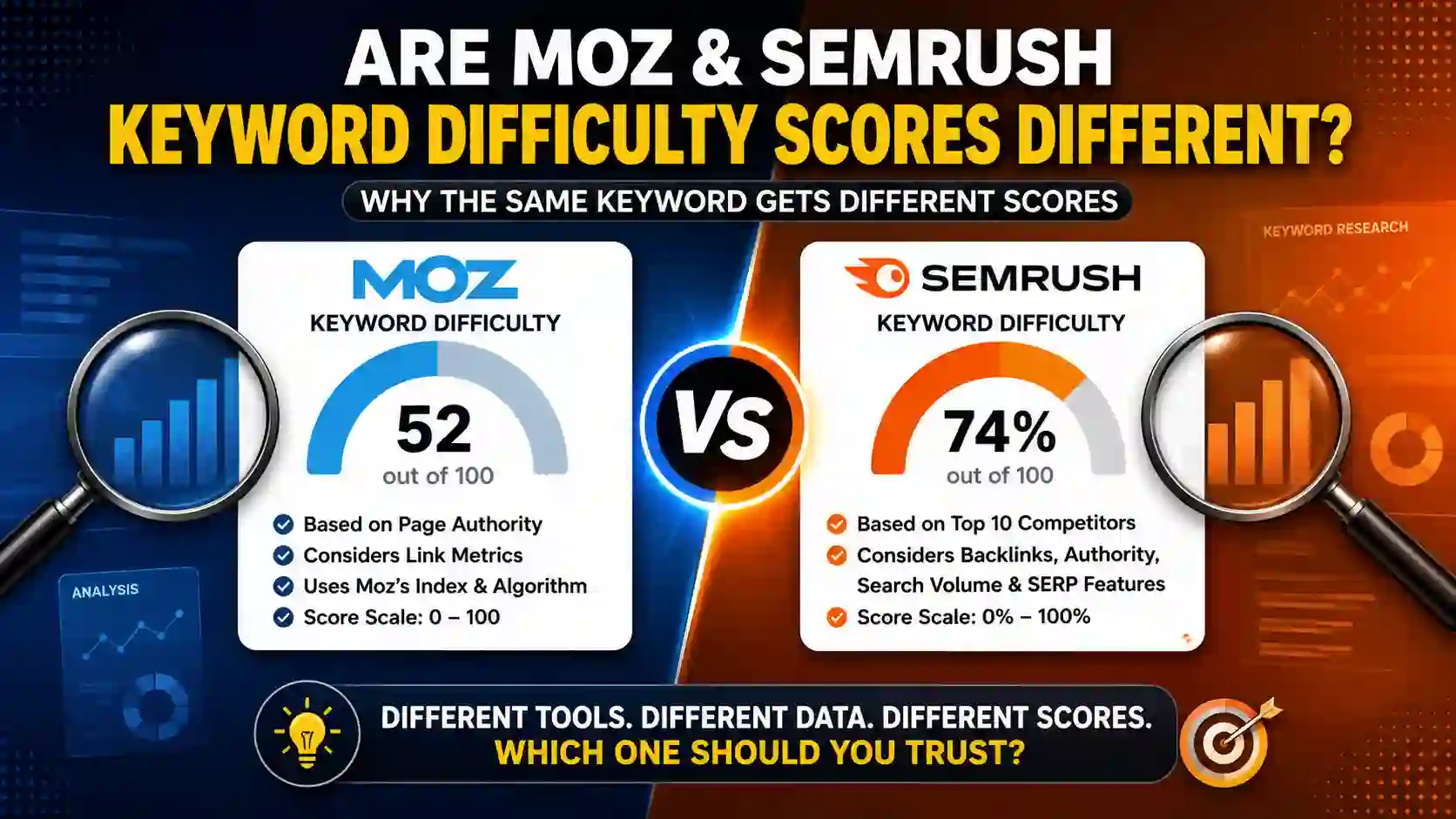
Are Moz Semrush Keyword Difficulty Score Differences? Complete Guide
When performing keyword research, it is common to enter the same keyword into different SEO tools and receive different keyword difficulty scores. Moz may show one number, while Semrush may show a considerably higher or lower number for exactly the same search term. This naturally raises an important question: are moz semrush keyword difficulty score differences normal, or does one tool provide inaccurate data?
The answer is yes, are moz semrush keyword difficulty score differences something you should expect when comparing SEO platforms. Moz and Semrush use different databases, algorithms, ranking data, backlink indexes, and methodologies to estimate how difficult it may be to rank for a keyword.
Keyword Difficulty is not an official Google metric. It is an estimate created by SEO platforms to help marketers understand the competitiveness of a search query. Semrush describes KD as a 0–100 percentage estimating how difficult it may be to rank in Google's top 10 results.
This means that a keyword with a Semrush KD of 70 should not necessarily have a Moz difficulty of 70. In fact, there is no reason to expect those numbers to match.
Understanding are moz semrush keyword difficulty score differences is important because keyword difficulty is often used to decide which keywords should be targeted in content, how much link-building may be required, and whether a website has a realistic chance of reaching Google's first page.
Quick Answer: Are Moz Semrush Keyword Difficulty Score Differences Normal?
Yes. Are moz semrush keyword difficulty score differences normal? Absolutely.
Moz and Semrush calculate keyword difficulty differently. They may also have different information about the websites currently ranking for a keyword.
For example, imagine you search for the keyword "best hosting for bloggers."
Moz might show:
Keyword Difficulty: 62
Semrush might show:
Keyword Difficulty: 74%
Another SEO platform might show 55.
This does not automatically mean one of the tools is wrong.
Each platform is making an independent estimate based on its own data.
Semrush's current Keyword Difficulty calculation considers factors such as referring domains pointing to ranking pages, the Authority Score of ranking domains, follow/nofollow link ratios, search volume, and various SERP features.
Moz uses its own keyword difficulty methodology and its own search and link data.
Therefore, are moz semrush keyword difficulty score differences should be understood as differences between measurement systems rather than simple errors.
Important Information About Moz and Semrush Keyword Difficulty
| Factor | Moz Keyword Difficulty | Semrush Keyword Difficulty |
|---|---|---|
| Metric type | Keyword competition estimate | Keyword competition estimate |
| Typical scale | 0–100 | 0–100% |
| Main purpose | Estimate ranking difficulty | Estimate ranking difficulty |
| Backlinks considered | Yes | Yes |
| Ranking pages considered | Yes | Yes |
| SERP characteristics | Considered in its methodology | Considered explicitly in current formula |
| Search volume | Used as part of overall keyword analysis | Included in current KD calculation |
| Authority signals | Moz's proprietary authority/link data | Semrush Authority Score and link signals |
| Database | Moz's own index | Semrush's own index |
| Google ranking factor | No | No |
| Scores expected to match? | No | No |
| Best use | Keyword comparison and competition research | Keyword research and competitive analysis |
| Personalization | Depends on tool/workflow | Semrush also offers Personal Keyword Difficulty |
| Recommended approach | Compare relative difficulty | Compare relative difficulty and SERP data |
The important takeaway is that a 60 in Moz is not automatically equivalent to a 60 in Semrush.
What Is Keyword Difficulty?
Before discussing are moz semrush keyword difficulty score differences, it is important to understand what Keyword Difficulty actually means.
Keyword Difficulty is an estimate of how challenging it may be for a webpage to rank prominently in organic search results for a particular keyword.
A keyword such as "SEO" is extremely broad and competitive.
A keyword such as "best SEO tools for small websites" is more specific.
A keyword such as "best SEO tools for small websites in India for beginners" is even more specific.
The longer and more specific keyword may have less competition, although this is not always the case.
Keyword difficulty helps SEO professionals prioritize opportunities.
For example:
| Keyword | Search Intent | Hypothetical Difficulty | Potential Strategy |
| SEO | Informational | 90 | Long-term authority building |
| SEO tools | Commercial/informational | 80 | Competitive content |
| Best SEO tools | Commercial | 75 | Strong content and backlinks |
| Best SEO tools for beginners | Commercial | 55 | More achievable |
| Best SEO tools for small websites | Commercial | 42 | Potential opportunity |
| Best SEO tools for small websites in India | Commercial | 32 | Potential long-tail opportunity |
These numbers are examples rather than actual current scores.
The important point is that difficulty is designed to help you compare keywords.
That brings us back to are moz semrush keyword difficulty score differences. Since keyword difficulty is an estimate rather than an official Google measurement, different platforms can legitimately produce different values.
Why Do Moz and Semrush Show Different Keyword Difficulty Scores?
There are several reasons behind are moz semrush keyword difficulty score differences.
The most important reasons include:
- Different keyword databases
- Different backlink databases
- Different ranking datasets
- Different authority calculations
- Different formulas
- Different weighting of ranking signals
- Different SERP analysis
- Different update schedules
- Different regional databases
- Different interpretations of competition
Each of these factors can influence the final score.
1. Different Backlink Databases
One of the biggest reasons behind are moz semrush keyword difficulty score differences is that Moz and Semrush do not have identical backlink databases.
The web contains billions of pages and links.
SEO platforms continuously crawl websites and discover backlinks, but they do not necessarily discover the same links at exactly the same time.
Imagine that the top 10 Google results for a keyword collectively have 100,000 backlinks.
Moz might have information about 75,000 of those links.
Semrush might have information about 82,000.
Another platform might have information about 90,000.
Even though they are analyzing the same Google results, their underlying data is different.
This can produce different difficulty estimates.
Backlinks are particularly important because established pages with many strong referring domains are generally harder to compete against.
Semrush's current methodology gives significant weight to the median number of referring domains pointing to ranking URLs.
Therefore, different backlink data can have a direct impact on are moz semrush keyword difficulty score differences.
2. Different Algorithms
The second major explanation for are moz semrush keyword difficulty score differences is that Moz and Semrush use different algorithms.
Think about two credit-rating companies.
Both companies may examine the same person but assign different scores because they use different formulas.
Keyword difficulty works similarly.
Moz has its own calculation.
Semrush has its own calculation.
Neither platform has access to Google's secret ranking algorithm.
Instead, both companies analyze available search results and SEO data to build predictive models.
Semrush explains that its current KD system analyzes the top-ranking pages and incorporates multiple signals, including backlinks, authority, search volume, and SERP features.
Consequently, are moz semrush keyword difficulty score differences are inevitable because the platforms are not trying to reproduce one universal formula.
3. Different Authority Metrics
Authority is another important factor.
Semrush has its own Authority Score.
Moz has metrics such as Domain Authority and Page Authority.
These metrics are not interchangeable.
Suppose the top 10 results for a keyword contain several highly authoritative websites.
Semrush may evaluate those domains using its Authority Score.
Moz evaluates them using its own authority data.
If Moz and Semrush assign different authority estimates to the same websites, the keyword difficulty calculation can also differ.
This is another important reason behind are moz semrush keyword difficulty score differences.
For example:
| Ranking Website | Moz DA Example | Semrush Authority Score Example |
| Website A | 78 | 71 |
| Website B | 65 | 58 |
| Website C | 52 | 46 |
| Website D | 48 | 54 |
| Website E | 41 | 38 |
These numbers are illustrative.
The point is that different authority metrics produce different inputs.
Therefore, you should not expect the final keyword difficulty scores to be identical.
4. Different SERP Analysis
Search results are more complicated than ten blue links.
Google may display:
- Featured snippets
- Local packs
- Shopping results
- Videos
- People Also Ask
- Knowledge panels
- Top stories
- Site links
- Images
- Other specialized search features
Semrush's current KD methodology explicitly incorporates several SERP features into its calculation, including featured snippets, instant answers, branded results, local packs, knowledge panels, top stories, People Also Ask, and site links.
This is another reason are moz semrush keyword difficulty score differences can occur.
A keyword with ten traditional organic results may behave very differently from a keyword where Google fills much of the screen with SERP features.
Even if both keywords have similar backlinks, the actual opportunity for organic clicks can be different.
5. Search Volume Can Influence Difficulty
Search volume is another factor.
High-volume keywords generally attract more SEO competition because they can generate significant traffic.
Semrush's current methodology includes search volume as one of the keyword-specific parameters used in KD calculations.
However, Moz and Semrush may have different estimates of search volume.
For example:
| Keyword | Moz Volume Example | Semrush Volume Example |
| SEO tools | 20,000 | 18,100 |
| SEO audit | 8,000 | 9,900 |
| Keyword research | 15,000 | 12,500 |
Different volume estimates can contribute to different difficulty calculations.
This helps explain are moz semrush keyword difficulty score differences when two tools show noticeably different numbers.
6. Regional Differences
Keyword difficulty can also vary by country and database.
A keyword may be extremely competitive in the United States but significantly less competitive in India.
Similarly, a keyword can have different search results in:
- United States
- India
- United Kingdom
- Canada
- Australia
- Germany
Search engines customize results according to location and other factors.
Semrush states that its current KD system includes regional calibration so that scores are adjusted according to regional databases and differences in search demand.
Therefore, if you compare Moz and Semrush without selecting the same country, you may create an even larger difference.
When investigating are moz semrush keyword difficulty score differences, always make sure that you are comparing the same:
- Country
- Search engine
- Language
- Keyword
- SERP type
- Device where applicable
7. Different Update Frequencies
Another reason behind are moz semrush keyword difficulty score differences is that SEO databases are constantly changing.
Consider a keyword that currently has:
- Three new authoritative websites
- Several lost backlinks
- Two ranking pages replaced
- A new featured snippet
- A change in search intent
The difficulty of the keyword may effectively change.
But SEO platforms may not update their databases at exactly the same moment.
Semrush says its Keyword Difficulty metrics are recalculated as ranking pages and SERP layouts change.
Moz has its own crawling and update processes.
Therefore, you could check the same keyword in both tools on the same day and still receive different results.
8. Top 10 Results Can Change
Google's search results are not static.
A page that ranked #2 yesterday may rank #7 tomorrow.
A new article may enter the top 10.
An established website may lose rankings.
A search result may change because Google's systems interpret the query differently.
Since keyword difficulty models depend on the competitive landscape, changes in the top-ranking pages can affect difficulty.
This is another explanation for are moz semrush keyword difficulty score differences.
If Moz has recently updated its ranking data but Semrush has not yet incorporated the same change, their scores may temporarily diverge.
Moz Keyword Difficulty Explained
To understand are moz semrush keyword difficulty score differences, you should also understand what Moz is trying to measure.
Moz Keyword Difficulty is intended to estimate how difficult it may be to rank for a keyword based on the competitive strength of pages appearing in the search results.
Moz's ecosystem includes authority measurements such as Domain Authority and Page Authority, which can help assess the strength of competing websites and pages.
The exact proprietary methodology matters less than the main concept:
Moz is attempting to turn competitive SERP information into a simple score that can be used for keyword comparison.
That score is useful for prioritization, but it should not be treated as an exact prediction.
For example, a keyword with a difficulty score of 70 is not guaranteed to require exactly twice as much effort as a keyword with a score of 35.
The scale is not a literal measurement of hours, backlinks, or content requirements.
Semrush Keyword Difficulty Explained
Semrush Keyword Difficulty is represented as a percentage from 0 to 100.
Semrush describes 0 as the lowest difficulty and 100 as the highest. Its current guidance groups scores into ranges such as very easy, easy, possible, difficult, hard, and very hard.
The current Semrush formula analyzes multiple characteristics of the keyword and its ranking pages.
Its published methodology gives major weight to:
- Median referring domains
- Median Authority Score
- Search volume
- Follow/nofollow ratio
- SERP features
Other factors are also included.
This makes Semrush KD a more complex model than simply counting backlinks.
Why a Keyword Can Be Easy in Moz but Hard in Semrush?
One common situation involving are moz semrush keyword difficulty score differences is when Moz reports a relatively low difficulty while Semrush reports a high difficulty.
Suppose:
Moz: 38
Semrush: 72%
Why might this happen?
Semrush may be identifying:
- Strong referring-domain profiles
- High-authority ranking domains
- Significant search volume
- Competitive SERP features
- Strong follow-link ratios
Moz may be weighting the same competitive environment differently.
This does not automatically mean Moz is wrong.
It means the two models are interpreting the SERP differently.
Why a Keyword Can Be Hard in Moz but Easier in Semrush?
The reverse can happen too.
Suppose:
Moz: 75
Semrush: 48%
Potential reasons include:
- Different backlink indexes
- Different authority calculations
- Different weighting systems
- Different SERP observations
- Different treatment of keyword characteristics
This is why are moz semrush keyword difficulty score differences should never be interpreted as proof that one tool is unreliable.
Are Moz and Semrush Scores Directly Comparable?
No.
This is one of the most important conclusions.
If Moz says:
Difficulty = 60
and Semrush says:
KD = 60%
you should not assume the keyword has exactly the same level of difficulty according to both platforms.
The shared 0–100 scale can be misleading.
A scale is only meaningful within the methodology that created it.
Think about school examinations.
A student could score:
- 80/100 on one exam
- 65/100 on another exam
That does not necessarily mean the student performed worse.
The exams could have different difficulty levels and scoring systems.
The same principle applies to are moz semrush keyword difficulty score differences.
Which Keyword Difficulty Score Should You Trust?
The better question is not which tool should you trust blindly.
Instead, ask:
Which tool gives me the most useful information for my specific SEO workflow?
If you use Semrush for most of your SEO research, it makes sense to use Semrush KD consistently.
If you use Moz for keyword research, you can use Moz's difficulty metric consistently.
You can also use both.
The important thing is to understand that the score is an estimate.
Do not treat it as a guarantee.
Should You Use Both Moz and Semrush?
Using both tools can be useful if you want multiple perspectives.
For example, you could create a keyword research spreadsheet containing:
| Keyword | Moz Difficulty | Semrush KD | Volume | Search Intent | SERP Competition | Decision |
| Keyword A | 35 | 42 | 1,200 | Informational | Moderate | Target |
| Keyword B | 68 | 79 | 12,000 | Commercial | High | Long-term |
| Keyword C | 44 | 31 | 900 | Informational | Low | Target |
| Keyword D | 72 | 66 | 8,500 | Commercial | High | Analyze |
| Keyword E | 25 | 29 | 500 | Informational | Low | Target |
This approach can help you identify keywords where both platforms indicate relatively low competition.
Those keywords may deserve closer examination.
What If Moz and Semrush Disagree Significantly?
Large differences should not automatically make you abandon the keyword.
Instead, manually inspect Google's search results.
This is one of the most valuable SEO habits.
Search the keyword and examine the first page.
Ask:
- Who is ranking?
- Are the ranking websites large brands?
- Are the ranking pages specifically optimized for the keyword?
- Do they have strong backlinks?
- Are smaller websites ranking?
- Does the content fully satisfy the search intent?
- Are forums or user-generated sites ranking?
- Are outdated pages ranking?
- Are exact-match pages ranking?
- Are there obvious content gaps?
This manual review can sometimes tell you more than a single difficulty number.
SERP Analysis Is More Important Than the Number Alone
Suppose Semrush says a keyword has a KD of 80%.
You manually check Google.
You discover that the top 10 results include:
- Three weak websites
- Two outdated articles
- A forum thread
- Several pages with poor content
- One major brand
That may represent a more interesting opportunity than the 80% score suggests.
Now consider another keyword with a KD of 45%.
You search Google and find:
- Wikipedia
- Amazon
- Forbes
- HubSpot
- Government websites
- Major industry publications
The keyword may actually be very difficult for your website.
This demonstrates why are moz semrush keyword difficulty score differences are not necessarily a problem. Difficulty scores are starting points for investigation, not final decisions.
Keyword Difficulty Does Not Know Everything About Your Website
Another important limitation is that general keyword difficulty usually describes the competitive landscape rather than perfectly predicting your individual chances.
Your website may have:
- Strong topical authority
- Relevant backlinks
- Existing rankings
- Strong internal linking
- High-quality content
- A trusted brand
Another website may not have those advantages.
This means the same keyword can be difficult for one site and achievable for another.
Semrush addresses this with Personal Keyword Difficulty, or PKD, which is designed to estimate difficulty specifically for a particular domain based on its authority and other context.
This is an important development because general keyword difficulty does not always tell the complete story.
General KD vs Personal Keyword Difficulty
Consider this example:
| Metric | Example |
| General Semrush KD | 72% |
| Personal KD for strong website | 54% |
| Personal KD for new website | 78% |
The same keyword can be much more realistic for one website than another.
This is why are moz semrush keyword difficulty score differences should be considered alongside your own website's strength.
If you have a relatively new website, a keyword with moderate difficulty may still require substantial effort.
If you have an established site with strong topical authority, the same keyword may be much easier.
What Is a Good Keyword Difficulty Score?
There is no universal "good" score.
A good keyword is one that provides a reasonable balance between:
- Search demand
- Ranking potential
- Business relevance
- Search intent
- Competition
- Conversion potential
For a new website, you may initially prioritize lower-difficulty keywords.
For an established website, you can target more competitive terms.
For example:
| Website Stage | Potential Strategy |
| New website | Lower difficulty, long-tail keywords |
| Growing website | Low-to-medium difficulty |
| Established website | Medium-to-high difficulty |
| Strong authority website | Competitive commercial keywords |
| Highly authoritative brand | High-volume competitive terms |
These are general strategic guidelines, not strict rules.
Why Low Keyword Difficulty Does Not Always Mean a Good Keyword?
A keyword can have a very low difficulty score and still be a poor target.
For example, it might have:
- Almost no search volume
- No commercial value
- Poor search intent
- No relevance to your website
- Very low conversion potential
Suppose a keyword has:
KD: 15
but only:
10 searches per month
It might not be worth creating a dedicated article for it.
Now consider another keyword:
KD: 35
with:
5,000 searches per month
The second keyword could be much more valuable.
Therefore, are moz semrush keyword difficulty score differences should never be analyzed independently from search volume and intent.
Keyword Difficulty vs Search Volume
These two metrics answer different questions.
Keyword Difficulty asks:
How difficult might it be to rank?
Search Volume asks:
How many searches does this keyword receive?
A successful keyword strategy balances both.
Consider:
| Keyword | Difficulty | Volume | Potential |
| A | 15 | 20 | Low |
| B | 30 | 800 | Good |
| C | 45 | 4,000 | Strong |
| D | 75 | 50,000 | Very competitive |
| E | 20 | 2,500 | Potentially excellent |
The ideal keyword depends on your website and business.
Keyword Difficulty vs Search Intent
Search intent is equally important.
A keyword may be easy to rank for but completely irrelevant to your business.
For example, if you sell hosting services, ranking for a random informational keyword with no connection to hosting may generate traffic but few customers.
Instead, you might prioritize keywords related to:
- Hosting comparisons
- Hosting coupons
- WordPress hosting
- VPS hosting
- Domain registration
- Website speed
- Hosting migrations
The goal is not simply traffic.
The goal is useful traffic.
Do Backlinks Determine Keyword Difficulty?
Backlinks are an important component of competitive SEO, but they are not the only factor.
Semrush's current Keyword Difficulty formula places substantial weight on referring domains and other link-related metrics.
However, Google rankings involve many other considerations.
A page with fewer backlinks can sometimes outrank a page with more backlinks because it may better satisfy search intent or provide more useful content.
Therefore, do not interpret a backlink count as an absolute ranking requirement.
How to Use Moz and Semrush Together?
A practical workflow can look like this.
Step 1: Build a Keyword List
Start with:
- Seed keywords
- Competitor keywords
- Related searches
- Questions
- Long-tail phrases
Step 2: Check Semrush KD
Record:
- KD
- Search volume
- Search intent
- SERP features
- Ranking competitors
Step 3: Check Moz Difficulty
Compare the same keywords in Moz.
Step 4: Identify Major Differences
Look for keywords where the scores are substantially different.
Step 5: Investigate the SERP
Manually inspect Google.
Step 6: Check Your Website Strength
Consider your:
- Authority
- Existing rankings
- Backlinks
- Topical relevance
- Content quality
Step 7: Prioritize
Choose keywords based on opportunity rather than simply selecting the lowest score.
This workflow makes are moz semrush keyword difficulty score differences useful rather than confusing.
Common Mistakes When Comparing Keyword Difficulty
Mistake 1: Expecting Identical Scores
Different tools use different formulas.
Mistake 2: Targeting Only Low-Difficulty Keywords
Low difficulty does not guarantee business value.
Mistake 3: Ignoring Search Intent
A keyword can have excellent metrics but poor relevance.
Mistake 4: Ignoring SERP Competition
Always look at the actual search results.
Mistake 5: Treating KD as a Google Metric
Keyword Difficulty is a third-party estimate.
Mistake 6: Comparing Different Countries
Make sure the same location is selected.
Mistake 7: Looking Only at Domain Authority
Page-level competition can matter significantly.
Mistake 8: Ignoring Content Quality
Backlinks are important, but useful content matters too.
How to Decide Which Tool's Score to Use?
If you are managing an SEO campaign primarily through Semrush, use Semrush KD as your primary benchmark.
If your workflow is centered around Moz, use Moz difficulty consistently.
If you have access to both, you can compare them.
A simple system could be:
Low in both tools: Strong candidate
Medium in both: Investigate
High in both: Competitive
Low in one and high in another: Perform manual SERP analysis
This approach turns are moz semrush keyword difficulty score differences into an opportunity to investigate keywords more carefully.
What Matters More Than Keyword Difficulty?
Ultimately, keyword difficulty is only one part of SEO.
You should also monitor:
- Organic traffic
- Impressions
- Click-through rate
- Rankings
- Referring domains
- Backlink quality
- Content depth
- Search intent
- Conversion rate
- Revenue
- Topical authority
If a keyword has a difficulty of 60 but generates thousands of dollars in revenue, it may be worth targeting.
If a keyword has a difficulty of 15 but produces no business value, it may not deserve your attention.
Conclusion: Are Moz Semrush Keyword Difficulty Score Differences a Problem?
So, are moz semrush keyword difficulty score differences a problem?
No. They are an expected result of using different SEO platforms.
Moz and Semrush are not using a universal keyword difficulty formula. Each platform has its own database, algorithms, authority measurements, ranking data, and interpretation of the competitive search landscape.
Semrush's current KD methodology evaluates multiple factors, including referring domains, Authority Score, search volume, follow/nofollow ratios, and SERP features.
This is why a keyword might have a difficulty of 45 in one platform and 65 in another.
Instead of asking which number is "correct," you should ask what the data tells you about the keyword.
If both tools show low difficulty, the keyword may deserve immediate attention.
If both tools show high difficulty, it may be a long-term target.
If one tool shows low difficulty and the other shows high difficulty, manually inspect the Google SERP.
Most importantly, do not build your entire SEO strategy around a single number.
Use Keyword Difficulty together with search volume, search intent, SERP analysis, backlinks, content quality, topical authority, organic traffic, and your website's existing strength.
The biggest lesson from are moz semrush keyword difficulty score differences is that keyword difficulty should be treated as a decision-making aid rather than an absolute prediction.
Your objective is not to find keywords with the lowest possible score. Your objective is to find keywords where the combination of ranking opportunity, search demand, relevance, and business value makes sense for your website.
Once you understand that Moz and Semrush are measuring the same competitive environment through different lenses, their different scores become much easier to interpret. Instead of being confused when the numbers do not match, you can use those differences to investigate the SERPs more deeply and build a smarter, more realistic keyword strategy.
Frequently Asked Questions
Verified Expert in deals and money-saving tips




No comments yet. Be the first to share your thoughts!