Namecheap vs SiteGround: Which Hosting Is Best in 2026?
Compare Namecheap vs SiteGround in 2026, including pricing, performance, WordPress hosting, security, backups, support, and features to find the best hosting for your website.
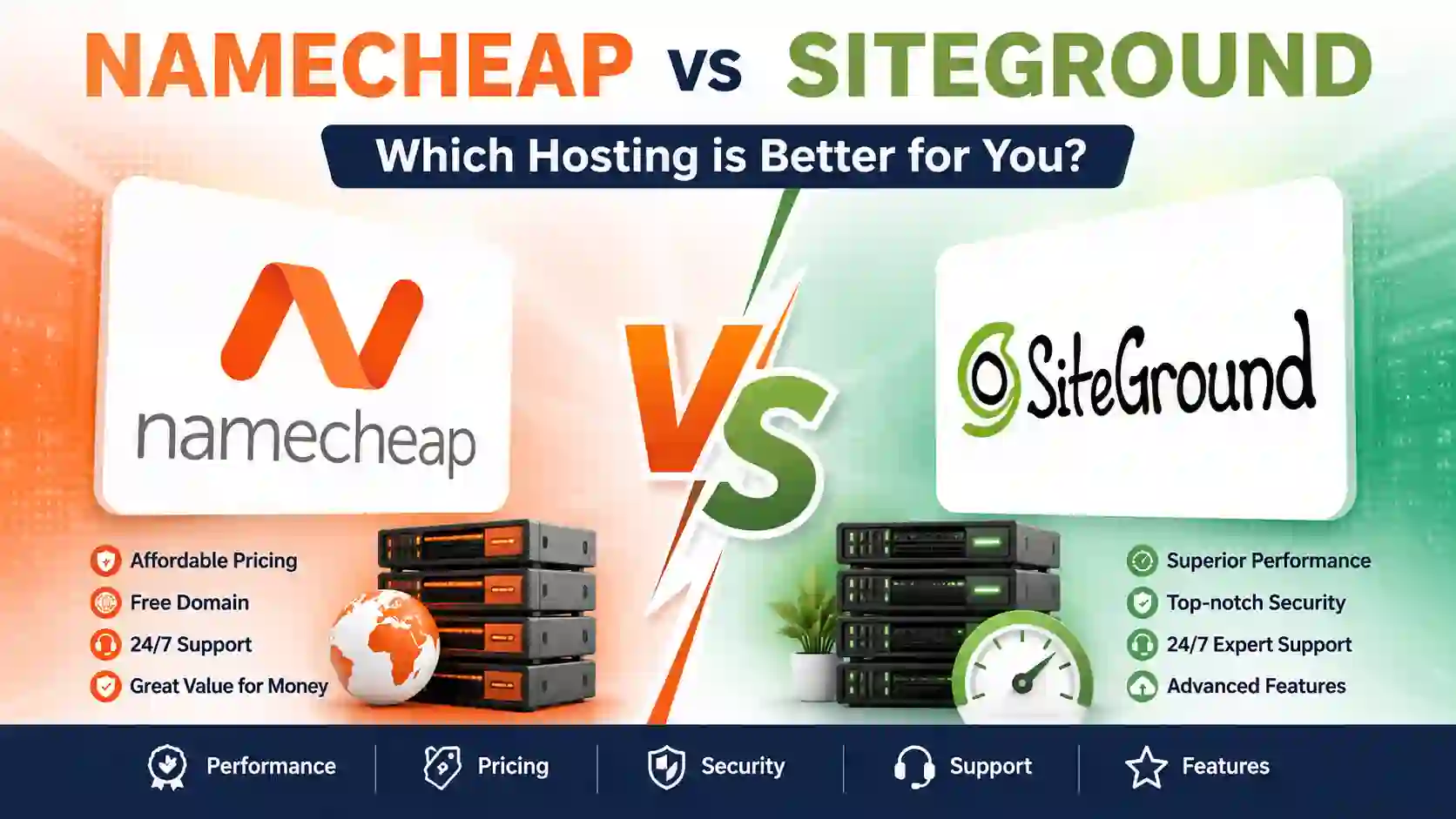
Namecheap vs SiteGround: Which Hosting Provider Is Better in 2026?
Choosing the right web hosting company can make a major difference in your website's speed, security, reliability, and long-term costs. Two popular names that frequently appear when people compare hosting providers are Namecheap and SiteGround.
If you are searching for Namecheap vs SiteGround, you are probably trying to decide which provider is better for your WordPress website, blog, small business, online store, or personal project.
Both companies offer domain registration, web hosting, SSL certificates, website migration, email services, and other tools. However, they take different approaches to hosting. Namecheap is well known for affordable domains and budget-friendly hosting, while SiteGround focuses more heavily on managed hosting, performance, security, WordPress features, and customer support.
In this detailed Namecheap vs SiteGround comparison, we will compare their hosting plans, pricing approach, performance, WordPress features, security, backups, customer support, ease of use, domains, email, scalability, and overall value.
The goal is simple: help you decide which hosting provider makes more sense for your website in the United States.
Namecheap vs SiteGround: Quick Comparison
Before getting into the details, here is a quick overview of the major differences.
| Feature | Namecheap | SiteGround |
|---|---|---|
| Best known for | Affordable domains and hosting | Managed, performance-focused hosting |
| Shared hosting | Yes | Yes |
| WordPress hosting | Yes | Yes |
| VPS hosting | Yes | Cloud/VPS-style solutions |
| Free SSL | Yes | Yes |
| Website migration | Free migration available | Free migration available |
| Automatic backups | Available | Available |
| Free CDN | Available with hosting features | Included with hosting plans |
| Email hosting | Yes | Yes |
| WordPress tools | Yes | Extensive |
| Website builder | Yes | Yes |
| Customer support | 24/7 support | 24/7 support |
| Beginner friendly | Yes | Yes |
| Performance focus | Good | Excellent |
| Budget focus | Strong | Moderate |
| Advanced WordPress features | Good | Excellent |
| Best for | Budget-conscious users | Businesses and performance-focused websites |
Namecheap currently promotes affordable shared hosting, WordPress-oriented EasyWP hosting, VPS options, free SSL, backups, malware protection on selected plans, and free hosting migration.
SiteGround focuses heavily on performance, managed WordPress hosting, Google Cloud infrastructure, caching, security, backups, CDN features, and 24/7 human support.
Important Namecheap and SiteGround Links
| Information | Namecheap | SiteGround |
| Official website | Namecheap | SiteGround |
| Web hosting | Namecheap Hosting | SiteGround Hosting |
| WordPress hosting | EasyWP | SiteGround WordPress Hosting |
| Domains | Namecheap Domains | SiteGround Domains |
| Support | Namecheap Support | SiteGround Support |
| Website migration | Available | Available |
| SSL | Free SSL available | Free SSL included |
| Backups | Available | Daily backups available |
What Is Namecheap?
Namecheap is a well-established domain registrar and hosting company. It became particularly popular among individuals and businesses looking for affordable domain registration, but it also provides a wide range of hosting services.
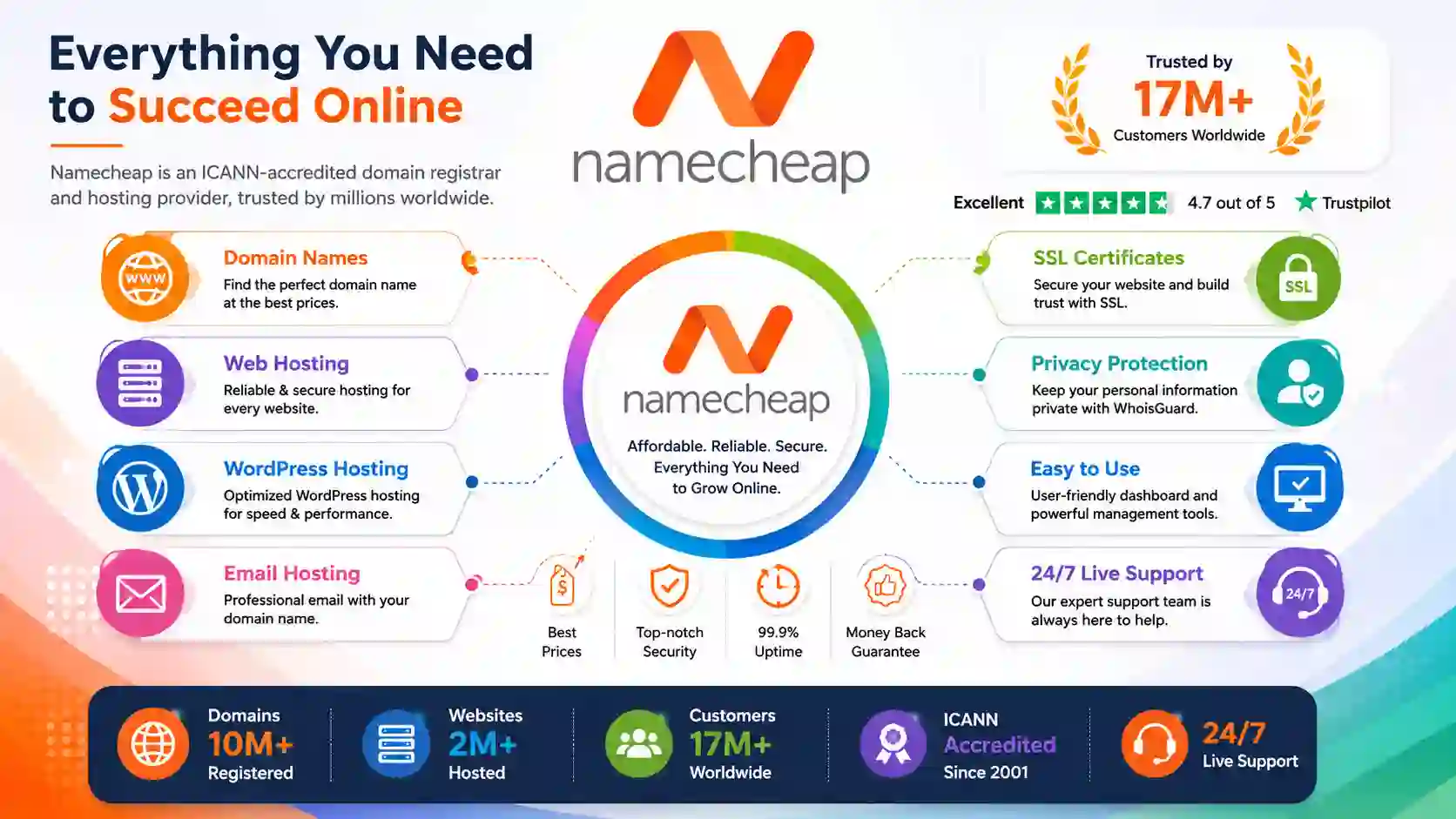
Its hosting portfolio includes shared hosting, WordPress hosting through EasyWP, VPS hosting, dedicated servers, email hosting, and other website services.
One of Namecheap's biggest advantages is its emphasis on affordability. Its current hosting offerings include low-cost shared hosting and EasyWP plans, making it attractive to bloggers, beginners, small websites, and people managing multiple domains.
Namecheap also provides free migration for new hosting plans and promotes features such as free SSL certificates, automatic backups, and malware protection on selected hosting plans.
For someone who wants to register a domain and host a relatively simple website without spending a lot of money, Namecheap can be an attractive option.
What Is SiteGround?
SiteGround is a hosting company known primarily for performance-focused web hosting and managed WordPress hosting.
Unlike providers that compete primarily on the lowest possible introductory price, SiteGround puts considerable emphasis on website performance, security, WordPress management, caching, backups, and support.

SiteGround's hosting platform uses Google Cloud infrastructure and includes technologies designed to improve website speed and reliability. The company also provides caching, CDN functionality, SSL, security features, automated backups, and WordPress management tools.
SiteGround also advertises 24/7 human support and offers website migration tools for customers moving existing websites.
For businesses, professional blogs, WooCommerce websites, agencies, and WordPress users who care strongly about performance and managed features, SiteGround can be a compelling choice.
Namecheap vs SiteGround: Pricing
Pricing is one of the biggest differences between Namecheap and SiteGround.
Namecheap generally has a strong advantage if your primary objective is keeping hosting costs low.
Its current hosting page lists shared hosting starting at a relatively low introductory price, along with EasyWP and VPS options at different price levels.
SiteGround also advertises low introductory prices, but the renewal price can be substantially higher after the promotional period. For example, SiteGround's current hosting page displays introductory pricing alongside higher renewal pricing.
This is extremely important when comparing hosting providers.
You should not compare only the first-year promotional price. Instead, calculate the total cost over two or three years.
For example, consider:
- Initial promotional price
- Renewal price
- Domain renewal
- Email costs
- Backup costs
- Premium security features
- CDN or performance add-ons
- Number of websites allowed
- Storage limitations
A hosting plan that looks cheaper during the first year may not necessarily be cheaper over several years.
Winner for Budget Hosting: Namecheap
If price is your primary concern, Namecheap generally has the stronger value proposition.
If you are willing to pay more for managed features and performance-oriented infrastructure, SiteGround becomes more attractive.
Namecheap vs SiteGround: Performance
Performance is one area where SiteGround has a strong advantage.
SiteGround's infrastructure uses Google Cloud and includes multiple performance technologies such as caching, CDN functionality, optimized PHP, and database performance improvements.
These features can be particularly valuable for WordPress websites.
Website performance depends on much more than the hosting company, though. Your theme, plugins, images, JavaScript, database, caching configuration, and content delivery strategy can all influence loading speed.
Namecheap can still provide perfectly acceptable performance for many smaller websites.
If you are operating:
- A small blog
- A personal website
- A basic business website
- A portfolio
- A low-traffic content website
Namecheap may provide sufficient performance.
However, for websites where speed and consistent performance are business priorities, SiteGround deserves serious consideration.
Performance Winner: SiteGround
SiteGround is the better choice if performance optimization is one of your most important requirements.
Namecheap vs SiteGround: WordPress Hosting
WordPress users have good options with both companies.
Namecheap offers EasyWP, a managed WordPress hosting service designed to simplify WordPress installation and management.
SiteGround takes WordPress hosting further with managed updates, migration tools, caching, security features, staging on higher-tier plans, WP-CLI and SSH access, and other WordPress-focused functionality.
For a basic WordPress blog, Namecheap may be more than enough.
For a professional WordPress website, business website, content-heavy publication, WooCommerce store, or website where performance matters, SiteGround is generally the stronger choice.
WordPress Winner: SiteGround
SiteGround wins if you want a more comprehensive managed WordPress experience.
Namecheap vs SiteGround: Security
Website security should be considered before price.
Both providers offer security-related features, including SSL certificates.
Namecheap promotes free SSL, automatic backups, and advanced malware protection through Imunify360 on selected hosting plans.
SiteGround provides SSL, security monitoring, anti-bot protection, DDoS-related protection, WordPress security tools, and other infrastructure-level security features.
SiteGround also provides a dedicated security plugin for WordPress that adds several security controls.
For a small website, Namecheap's security features can be sufficient.
For a business website that needs a more managed security environment, SiteGround has an advantage.
Security Winner: SiteGround
Namecheap vs SiteGround: Backups
Backups are essential because websites can fail for many reasons.
A plugin update can break WordPress. A developer can accidentally delete files. A website can be compromised. A database can become corrupted.
Namecheap provides automatic backups as part of its hosting offerings, although exact backup features depend on the plan.
SiteGround places a strong emphasis on automated backups. Its hosting plans include daily backups, while its documentation explains how customers can access and restore files, databases, and emails from backups.
SiteGround's current hosting information also describes daily backup functionality and backup history.
Backup Winner: SiteGround
SiteGround has a particularly strong backup and recovery experience.
Even with either provider, however, I recommend maintaining an independent backup of important websites.
Namecheap vs SiteGround: Customer Support
Customer support becomes extremely important when your website stops working.
Both companies provide 24/7 support.
Namecheap is popular among users who want relatively straightforward hosting and domain management.
SiteGround has built its reputation heavily around customer support and managed hosting. Its website currently emphasizes 24/7 expert human support.
For beginners, this can be particularly valuable.
If you are comfortable troubleshooting WordPress, DNS, databases, PHP, plugins, and hosting settings yourself, support may be less important.
If you prefer having a hosting company help with technical problems, SiteGround is worth considering.
Support Winner: SiteGround
Namecheap vs SiteGround: Ease of Use
Both providers are relatively beginner friendly.
Namecheap provides tools for managing domains, hosting, files, websites, and other services.
SiteGround uses its own Site Tools platform for hosting management. It is designed to make common tasks such as website management, backups, SSL, email, domains, and performance settings accessible from a central interface.
For complete beginners, either provider can work.
However, the best choice depends on what you are trying to build.
If you primarily need a cheap domain and straightforward hosting, Namecheap is appealing.
If you want a more managed WordPress experience, SiteGround is more attractive.
Ease-of-Use Winner: Tie
Namecheap vs SiteGround: Domains
Namecheap has a major advantage when it comes to its identity as a domain registrar.
If you frequently purchase domains, manage multiple domains, use different extensions, or operate several websites, Namecheap can be very convenient.
SiteGround also offers domain registration, so you can purchase a domain and hosting from the same company.
However, many experienced website owners intentionally separate their domain registrar from their hosting provider.
For example, you could register your domain with one company and host your website with another.
This gives you greater flexibility if you decide to move your website later.
Domain Winner: Namecheap
Namecheap is the stronger choice if domain registration is an important part of your requirements.
Namecheap vs SiteGround: Free SSL
SSL is essential for modern websites.
It encrypts connections between visitors and your website and allows your website to use HTTPS.
Both Namecheap and SiteGround provide free SSL options.
Namecheap states that free SSL certificates are included with its hosting plans.
SiteGround automatically provides free SSL certificates for hosted websites and integrates Let's Encrypt into its platform.
SSL Winner: Tie
Both providers offer what most website owners need.
Namecheap vs SiteGround: Website Migration
Moving an existing website can be stressful.
A poorly executed migration can result in:
- Downtime
- Missing images
- Broken links
- Database errors
- Email problems
- DNS issues
- WordPress configuration problems
Namecheap provides free migration for new hosting plans and says its team can handle migration for customers.
SiteGround also offers free website migration and WordPress migration tools.
Migration Winner: Tie
Both are strong choices for users who want assistance moving an existing website.
Namecheap vs SiteGround: Email Hosting
Professional email is important for businesses.
An address such as [email protected] looks more professional than using a generic consumer email address.
Namecheap provides email hosting and also offers Private Email as a separate service.
SiteGround also includes professional email functionality with its hosting plans.
If email is a major requirement, compare the exact mailbox limits, storage, spam filtering, and pricing of the specific plans you are considering.
Email Winner: Tie
Namecheap vs SiteGround: Which Is Better for Small Businesses?
For a small business website, both companies can work.
Namecheap is attractive for businesses that want to keep operating costs low.
For example, a local service business with a five-page WordPress website may not need all the advanced hosting features offered by SiteGround.
SiteGround makes more sense if the website is directly connected to revenue and performance.
Examples include:
- Online stores
- Marketing websites
- SaaS landing pages
- High-traffic blogs
- Membership websites
- Lead-generation websites
- Professional WordPress websites
Small Business Winner: SiteGround for performance, Namecheap for budget
Namecheap vs SiteGround: Which Is Better for Bloggers?
For a new blogger, Namecheap can be a good starting point.
If your blog receives relatively little traffic and your primary objective is minimizing expenses, Namecheap provides a cost-effective route into website ownership.
However, if your blog grows significantly, performance becomes more important.
A high-traffic blog may benefit from better caching, CDN functionality, optimized infrastructure, automated backups, and managed WordPress features.
Therefore, SiteGround is the better long-term choice for bloggers who expect their website to grow.
Blogger Winner: Namecheap for beginners, SiteGround for growing blogs
Namecheap vs SiteGround for WooCommerce
WooCommerce websites have different requirements from simple blogs.
An online store needs:
- Reliable hosting
- Good database performance
- SSL
- Backups
- Security
- Caching
- Scalability
- Reliable uptime
- Good support
SiteGround has dedicated WooCommerce hosting and emphasizes performance, security, backups, and WordPress management.
Namecheap can also host WordPress and ecommerce websites, but SiteGround's managed environment is generally better suited to businesses where ecommerce performance is important.
WooCommerce Winner: SiteGround
Namecheap vs SiteGround: Which Is Better for the USA?
For users in the United States, both providers can be considered.
Your choice should not be based solely on where the company is headquartered. More important factors include:
- Server infrastructure
- CDN availability
- Website caching
- Visitor location
- Server resources
- Database performance
- Support
- Pricing
- Renewal costs
If most of your visitors are located in the United States, you should configure your hosting and CDN strategy around US traffic.
SiteGround's Google Cloud-based infrastructure and performance tools make it attractive for US-focused websites.
Namecheap can still be a good choice if you are building a small US-focused website and want to keep costs low.
Namecheap vs SiteGround: Pros and Cons
Namecheap Pro and Cons
Pros
Cons
SiteGround Pro and Cons
Pros
Cons
Who Should Choose Namecheap?
Choose Namecheap if:
- You want affordable hosting
- You frequently register domains
- You are launching a small website
- You are building a personal blog
- You are starting with a limited budget
- You need basic WordPress hosting
- You want to manage several domains
- You do not need advanced managed hosting features
For beginners who are primarily concerned with price, Namecheap is an excellent candidate.
Who Should Choose SiteGround?
Choose SiteGround if:
- Website performance is a priority
- You run WordPress
- You operate an online store
- You run a business website
- Your website is growing
- You want managed hosting features
- You want strong backup and security tools
- You value 24/7 human support
- You want built-in caching and CDN functionality
- You want a hosting environment designed around performance
For serious WordPress websites and growing businesses, SiteGround is generally the stronger overall choice.
Namecheap vs SiteGround: Final Verdict
So, which one wins the Namecheap vs SiteGround comparison?
The answer depends on your priorities.
If your main goal is affordable hosting and domain management, Namecheap is the better option.
If your priority is performance, managed WordPress hosting, security, backups, support, and long-term website growth, SiteGround is the better choice.
For a simple personal website, portfolio, or low-cost blog, I would lean toward Namecheap.
For a business website, professional blog, WooCommerce store, content-heavy website, or website where speed and reliability directly affect revenue, I would choose SiteGround.
The most important thing is to compare the total cost rather than looking only at the introductory price. Hosting providers frequently use promotional pricing, and renewal costs can be considerably different from the initial price.
For US website owners, both providers are capable options. Your final decision should come down to your budget, website type, expected traffic, WordPress requirements, performance expectations, and how much technical management you want to handle yourself.
Overall, Namecheap wins on affordability and domain-related value, while SiteGround wins on managed hosting, performance, WordPress features, and business-focused hosting.
Conclusion
The Namecheap vs SiteGround decision ultimately comes down to what you value most.
Namecheap is an excellent option for users who want affordable hosting, domain registration, basic WordPress hosting, and a straightforward way to get a website online. It is particularly attractive for beginners, personal websites, small blogs, and budget-conscious website owners.
SiteGround is better suited to users who prioritize performance, managed WordPress hosting, security, backups, caching, support, and scalability. It is especially compelling for businesses, professional bloggers, ecommerce websites, agencies, and growing websites.
If you are building your first small website and want to keep expenses under control, Namecheap is the better choice.
If your website is important to your business and you want a more performance-focused managed hosting environment, SiteGround is the better choice.
In short:
Choose Namecheap for affordability and domains. Choose SiteGround for performance and managed hosting.
Before purchasing either service, check the current plan features, promotional price, renewal price, storage limits, website limits, and included features. Hosting prices and plans can change over time, so the exact cost at checkout should always be treated as the final price.
Watch Video: https://youtu.be/EoNF45hE8cY?si=vKEXTxUzDchXv8DE
Frequently Asked Questions
Verified Expert in deals and money-saving tips


No comments yet. Be the first to share your thoughts!